Showing posts with label Virtual. Show all posts

Thursday, March 1, 2012

bench3

Windows Cannot Read The ProductKey Setting From The Unattend answer file | Solution

Almost every one will face this issue when installing Windows 8 on Virtual machines. This is what happened to me while installing Windows 8 Developer Preview on VMware Workstation 8 .0 build 471780.

I have created New Virtual Machine for Windows 8, but while installing Windows 8 it gives me "Vmware Workstation 8 Windows Cannot Read the <ProductKey> settings from the unattend answer file" error. And Windows 8 virtual machine keeps on rebooting...In VMware Workstation 8.0 "Windows 8" Version is a not available under.

Error Message, "Windows cannot read the <ProductKey> setting from the unattend answer file."

Windows Cannot Read The ProductKey Setting from the Unattend answer file

Solution:

Solution is so simple, remove or Disconnect "Floppy" from your Windows Virtual Machine. Because, what happens actually is the autoinst.flp file contains the ProductKey. And  autoinst.flp is mounted when you start the Virtual Machine VMware.

Right click on the floppy icon on the right bottom corner on the VMware, and click on settings.

ProductKey setting from the unattend answer file

Un tick, Connected and Connect at Power On under Device status and click Ok.

Windows cannot read the ProductKey setting from the unattend answer

Now you can install Windows 8 without any issues. And by any chance if Windows 8 installation ask you to type a product key, just key in this Product Key: DNJXJ-7XBW8-2378T-X22TX-BKG7J

Enjoy!!

Alternatively, you can also remove the floppy completely from the Virtual machine, just follow these steps.

If you are Windows 8 Virtual Machine is running, power off Windows 8 Virtual Machine & Go to Virtual Machine settings & remove the Floppy.

Windows ProductKey Setting from the Unattend answer file.

Hyper-V does not enable floppy drives by default, and MDT does not use the floppy drive at all.

Product Key: DNJXJ-7XBW8-2378T-X22TX-BKG7J

Read More

Friday, September 16, 2011

bench3

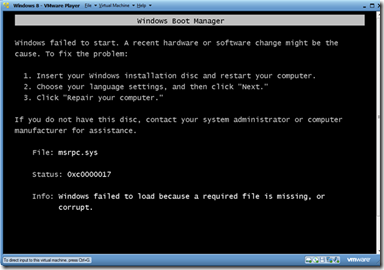
Error 0XC0000017 Windows Failed To Load Because A required File Is Missing Or Corrupt

When you are trying to Install Windows 8 on Virtual Machine, you will come across the following error message. “Error 0XC0000017 Windows Failed To Load Because A required File Is Missing Or Corrupt”.

Initially Windows Setup will ask you to restart your System. But unfortunately, a restart will not make any difference.

Even if you are trying to Install Windows 8 on Windows Virtual PC, you will not find any success that Windows 8 can not be installed on Windows Virtual PC, this is very strange but actually, it is true.

And the reason for that is very similar to my older post that, Windows 8 to be installed you need to have the latest Virtual Machine Software.

The supported Virtual Machines are,

  • VMware WorkStation 8,
  • Oracle VM VirtualBox
  • VMware Fusion for MACOSX

If you are seeing something like this, HAL_INITIALIZATION_FAILED. and followed by a message that “Your PC ran into a problem that it couldn't handle, and now it needs to restart. You can search for the error online: HAL_INITIALIZATION_FAILED” You can read more on my previous post for that problem. http://www.bench3.com/2011/09/fix-halinitializationfailed-error.html.

Error 0XC0000017 Windows Failed To Load Because A required File Is Missing Or Corrupt

However, the solution for both the problem is same. We need an latest Virtual Machine Software. Something as what we said above.

Try Windows 8 Now! And if you have not downloaded Windows 8, just head on to Microsoft's developer site and download it. You'll just need a PC with a 1GHz or faster processor (either 32- or 64-bit), 1GB of RAM (2GB for 64-bit), 16GB of hard disk space (20GB for 64-bit), DirectX 9 graphics with WDDM 1.0 or higher driver. Of course, if you want to play with Windows 8's touch abilities, you'll need a screen that supports multi-touch.

Read More

Wednesday, September 14, 2011

bench3

HAL_INITIALIZATION_FAILED Error Message On Installing Windows 8 | Solution To HAL_INITIALIZATION_FAILED

In my earlier post, we have discuss where to Download Windows 8 Developer Edition. If you have successfully downloaded Windows 8 and when you are installing Windows 8 as Virtual machine on VMware Workstation or on Microsoft Virtual PC you may get the following Error, HAL_INITIALIZATION_FAILED. and followed by a message that “Your PC ran into a problem that it couldn't handle, and now it needs to restart. You can search for the error online: HAL_INITIALIZATION_FAILED”

If you have not downloaded Windows 8, just head on to Microsoft's developer site and download it. You'll just need a PC with a 1GHz or faster processor (either 32- or 64-bit), 1GB of RAM (2GB for 64-bit), 16GB of hard disk space (20GB for 64-bit), DirectX 9 graphics with WDDM 1.0 or higher driver. Of course, if you want to play with Windows 8's touch abilities, you'll need a screen that supports multi-touch.

However if you want to test Windows 8 on a Virtual machine, you need to have the latest Virtual machine software, say for example, VMWare 8, VirtualBox, etc. This means, if you are using VMware 7 or earlier version, its time to upgrade your Software's.

Windows 8 Users are reporting success using a few products. Of the most popular options, Microsoft's baseline assessment is as follows:

Functional:

  • Hyper-V in Windows 8 Developer Preview
  • Hyper-V in Windows Server 2008 R2
  • VMware Workstation 8.0 for Windows
  • VirtualBox 4.1.2 for Windows

Non-functional:

  • Microsoft Virtual PC (all versions)
  • Microsoft Virtual Server (all versions)
  • Windows 7 XP Mode
  • VMWare Workstation 7.x or older

Now it is clear that, Windows 8 works on VMware 8 Workstation, Now, where to get VMware 8 Workstation?

Download VMware 8 Workstation From this location. Note: VMware is not a free edition, but you could try it for 30 days, at least we hope before which we can get a positive work around to install in our other Virtual Machine Software. Also, you can always get the VMware 8 on torrents. Here is a Google search result for VMware 8.

We suggest you to install Windows 8 on VMware 8 Workstation. Read my recent article explaining the Step by Step Instructions To Install Windows 8 on VMWare Workstation 8.

Important: You can install Windows 8 on Oracle VM VirtualBox and also have posted a step-by-step instructions on Installing Windows 8 on Oracle VM VirtualBox. But since most of you are experiencing problem installing Windows 8 on Oracle VM VirtualBox, We suggest you to install Windows 8 on VMware 8 Workstation. Read my recent article explaining the Step by Step Instructions To Install Windows 8 on VMWare Workstation 8.

HAL_INITIALIZATION_FAILED on After downloading the 32bit ISO from http://msdn.microsoft.com/en-us/windows/apps/br229516, I failed to install Windows8 on VMware Workstation.

It also happed to me when I first installed Windows 8 on Vmware 7. When I start installing, the first screen was "Loading Files", second was "Windows Developer Preview" and on third there was an error in blue background as:

Fix HAL_INITIALIZATION_FAILED Error Message Installing Windows 8

Your PC ran into a problem that it couldn't handle, and now it needs to restart. You can search for the error online: HAL_INITIALIZATION_FAILED

I tried several times but the error is same. Please let me know if there is any way to solve this issue. Thank you in Advance.

Fix HAL_INITIALIZATION_FAILED Error Message Installing Windows 8 1

We need at least the beta version 8.x of VMware Workstation to load the developer Build. For me, the solution was to install VirtualBox. Read the Instructions On How to install Windows 8 on Oracle VM VirtualBox. VMware 8 (even the beta version of VMware 8 Workstation ) will support Windows 8.

However, VMware 8 Workstation is about 500MB and Oracle VM VirtualBox is just around 18 MB. And we already have posted the Step-by-Step Instructions On How to install Windows 8 on Oracle VM VirtualBox also Explained With Screen Shots which will be more useful if you interested to try Oracle VM VirtualBox.

If we are installing Windows 8 on VMware 8, unless we install the VMware Tools on the virtual OS, we will not be able to use any App in Windows 8 Virtual Machine. So, immediately after installing Windows 8 on VMware, Install VMware Tools on the virtual OS.

As far as i have experimented, only after installing the VMware tools, I was able to use all the Apps in Windows 8 operating system.

Read More

Sunday, September 4, 2011

bench3

Cloud Backup Possible On Windows 8

There's new evidence to back up speculation that the next version of Windows (Windows 8) may feature cloud-based backup. The idea is based on two recent Microsoft job posts which discuss a possible connection between Windows Azure, web-based services and Windows 8.

The first job posting is looking for a Software Development Engineer to help with work "on a Windows Azure-based service and integrating with certain Microsoft online services and Windows 8 client backup." The second job posting seeks a Windows System Engineer to "play a pivotal role as we integrate our online services with Windows 8."

The job listings follow a set of slides leaked over the summer that suggest cloud-based computing would play a vital role in Windows 8. The deck of slides listed features supposedly under consideration including ultra-fast booting, a "Microsoft Store" for downloading apps, fuller cloud integration, and the use of facial recognition for logins.

According to one of the slides, Windows accounts would be connected to the cloud. Roaming settings and preferences would also be associated with a user between PCs and devices. Ultimately this may actually help Microsoft fight piracy both locally and overseas, authorizing users on Microsoft’s end rather than locally on the machine.

Cloud Backup Possible On Windows 8.jpg

Additionally, a possible scenario could require customers to set up a Live account (or use an existing one), purchase an access key (or register if Windows 8 came pre-installed on a new PC), and download the OS when needed later, similar to purchasing games from Steam. There would be no need for discs or permanently storing installation files on the HDD.

But if Windows 8 will indeed support cloud-based backup, it will be interesting to see how it works. Backing up to an internal HDD or an external 2 TB HDD is one thing--backing up the contents of a hard drive across the Internet is an entirely different beast. Cloud-based backup will likely just keep track of the core OS so that users can perform a recovery process.

With a clear connection between Windows 8 client backup and Windows Azure-based service listed in the job posting, there's no question that cloud-based computing will play a major role in the next OS. How it will be implemented will be anyone’s guess over the next few years.

Read More

Saturday, September 3, 2011

bench3

Windows 8 Supports Mounting VHD Files As Physical Hard Disk Drive

In continuing with the improvements in core Windows functionality and also oft-requested features, Microsoft were adding native Explorer support for ISO and VHD files in Windows 8.

While terabytes of storage are available to all of us, managing disk (or disc) image formats remains important for a number of mission-critical operations in many organizations and among power users. We have already discussed about new ISO Mount Feature on Windows 8 in my previous post, and here lets see what Windows 8 has to do with the VHD Files. More support for VHD is a big request, so stay tuned for Windows 8, powerful Operating System from Microsoft.

Another place what Microsoft have simplified access is with Virtual Hard Disk files. Virtual Hard Disks are the format used by Virtualization software Hyper-V or Virtual PC.

The Virtual Hard Disk (VHD) format is a publicly-available image format specification that allows encapsulation of the hard disk into an individual file for use by the operating system as a virtual disk in all the same ways physical hard disks are used.

The VHD format is used by Hyper-V to store information for Virtual Machines. In Windows7 & Windows Server 2008 r2 we have the ability to boot the system off a VHD file, and we had command line and MMC plugins for managing them. VHDs are handy for portability of system settings or to play back what has been saved as a snapshot of a system.

Accessing a VHD in Windows 8 is as simple as what we’ve done with ISO files, but there is one important difference: rather than appearing as a removable drive (as is the case with ISO), VHDs appear as new hard drives.

Accessing a VHD

Underneath the covers, Windows provides a virtual drive letter pointing to the volume within the VHD. You’ll notice that the icon for the drive G: below is the same as the icon for a VHD file.

Windows 8 Supports Mounting VHD Files As Physical Hard Disk Drive 1

Figure: The VHD appears as a hard drive

You can then work with the virtual hard disk just like any other file storage in your system, whether you are modifying, adding or removing files.`

Windows 8 Supports Mounting VHD Files As Physical Hard Disk Drive 6

Figure: Ejecting the VHD

Once you’ve finished working with the VHD, like an ISO, you can right-click it and click Eject (or just use the Eject button on the ribbon). Any changes you’ve made remain saved within the file.

Here’s a quick demo to show you what it looks like to mount ISOs and VHDs on a new “Windows 8” system. Download this video to view it in your favourite media player:
High quality MP4 | Lower quality MP4

Read More

Thursday, July 28, 2011

bench3

Find Out If Desktop Virtualization Is Right For You

Desktop virtualization (sometimes called client virtualization), as a concept, separates a personal computer desktop environment from a physical machine using the client–server model of computing.

Virtual desktop infrastructure, sometimes referred to as virtual desktop interface (VDI) is the server computing model enabling desktop virtualization, encompassing the hardware and software systems required to support the virtualized environment.

Many enterprise-level implementations of this technology store the resulting "virtualized" desktop on a remote central server, instead of on the local storage of a remote client; thus, when users work from their local machine, all of the programs, applications, processes, and data used are kept on the server and run centrally. This allows users to run operating system and execute applications from a Smartphone or thin client which exceed the user hardware's ability to run.

Find Out If Desktop Virtualization Is Right For You

In my earlier post, we have seen what are the benefits of Virtual desktop infrastructure.  Now, how to say if the Desktop Virtualization is right for the situation? Well, that’s the next question to ask.

How To Find If Desktop Virtualization Is Right for You:

First and foremost, you know your user’s best. So I recommend you evaluate the “required” capabilities that users must have to perform their jobs and then look at virtualization as an enabler. That said, I do recommend every customer evaluating desktop virtualization ask themselves the following questions:

  • Do my users need to access information and applications when they are connected or disconnected from the network?
  • Do my users work with data that is sensitive and must be highly secured?
  • Do my users need to be able to customize their desktop so that if feels personal for them?
  • Do I need to consider how non-windows devices will access Windows applications?
  • Do my users need multiple windows environments (Dev.-Test Environment/ Business-Personal Environments)?

Based on those answers, you can start working on a desktop virtualization plan that works best for you and your workers unique needs.

Read More